



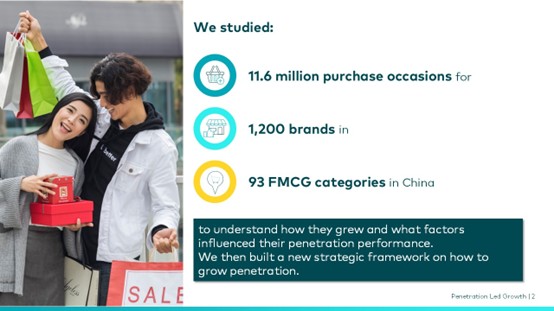
For years, FMCG brand managers in China have debated the relative merits of acquiring new buyers versus increasing frequency among existing ones. A landmark meta study by Worldpanel by Numerator, a CTR service in China, has now settled the argument decisively. Analysing 11.6 million purchase occasions across 1,200 brands in 93 FMCG categories, the research reveals with striking clarity that more than 9 out of 10 brands that grow do so by increasing the number of shoppers who buy them. This is true no matter the brand size. This finding echoes a central thesis of Byron Sharp's seminal work, How Brands Grow: that brand growth is primarily driven by penetration — attracting more buyers — rather than by squeezing more frequency from an existing loyal base.
The China data doesn't just confirm Sharp's theory in principle; it quantifies it at scale, across one of the world's most complex and competitive consumer markets. The implications for how brand owners think about strategy, investment, and measurement are profound.
Why You Cannot Stop Recruiting New Buyers
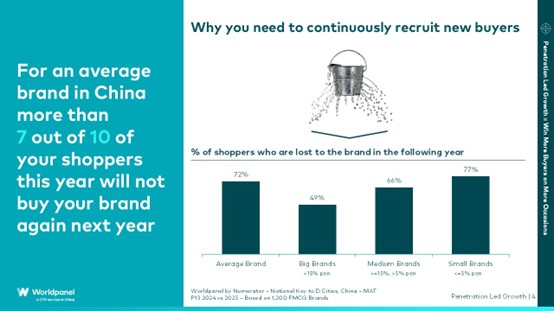
The urgency of penetration-led thinking becomes even clearer when you look at buyer retention. For the average brand in China, more than 7 out of 10 shoppers this year will not buy that brand again next year. This is not a failure of product quality or brand love — it is simply the nature of how consumers shop. Seven in ten buyers purchase a brand only once per year, making it mathematically inevitable that buyer bases erode quickly without constant replenishment.
The practical implication is important: even if you do nothing wrong, your brand is leaking buyers continuously. Growth, therefore, requires not just retaining existing shoppers but actively recruiting new ones to replace those lost and then some. Frequency-only strategies hit a ceiling fast — as a simple illustration shows, converting 25 one-time buyers to purchase twice generates 12.5kg of additional volume, whereas recruiting 25 brand-new buyers generates 18.8kg — 50% more volume — because new buyers also bring fresh occasions. Across China's real categories, the gap is consistent: in CSD for example, one million new Fanta buyers would add 2.6 million litres, while one million existing buyers making one extra trip would add just 1.6 million litres.
Finding and Targeting Your Non-Buyers
Before acting, brands need to understand who is not buying them and why. Even big brands have significant headroom — for the average large brand, 2 in 3 category shoppers do not buy them. Non-buyers can be identified and prioritised through several methods: demographic or geographic profiling, behavioural analysis (such as targeting heavy category buyers who have never tried your brand, or lapsed buyers), lookalike analytics that identify non-buyers who resemble your existing customer base, and broader shopper segmentation. The choice of approach will depend on data access and ambition, but the starting point is always to scope the potential and quantify the prize.

The Four Drivers of Penetration Growth
Worldpanel China's Penetration Led Growth framework identifies four levers that brand owners can pull to win more buyers.

1. Build Brand Salience. Awareness is foundational: it explains around 56% of the difference in penetration size between brands. Yet awareness alone is not sufficient — only 21% of people who know a brand actually purchase it, with the largest drop-off occurring between consideration and purchase. The implication is twofold: invest in broad-reach media to build awareness, and then work hard to convert that familiarity into a buying decision. Campaigns that reach more than 70% of their audience grow penetration three times faster than those reaching below 30%. This maps directly onto Sharp's concept of mental availability — being the brand that comes to mind first, in the right context, at the right moment.
2. Expand Market Footprint. Physical availability is the other pillar of Sharp's framework, and the China data is emphatic on its importance. Brands not available across all provinces will struggle to exceed 1% national penetration — they are simply nine times smaller than those with nationwide coverage. Channel breadth matters just as much: brands present in 15 or more channels achieve penetration three times higher than those in 13 channels, while brands available in 300 or more named retailers reach penetration six times higher than those in 150–199. To reach 10% penetration, a brand needs to be stocked in more than 250 named retailers.
3. Win at Point of Purchase. Once a shopper encounters your brand, you need to convert. Portfolio breadth across price tiers is critical: brands that stretch across low, mid, and high price tiers achieve more than twice the penetration of those that don't. Range size also plays a role — brands with at least 150 SKUs can reach 10% of shoppers, and broader ranges generally capture more buyers. However, range optimisation is just as important as range breadth: on average, brands can remove around 11% of their SKUs without any reduction in penetration, meaning many brands are carrying dead weight that adds cost without adding buyers. The discipline is to keep SKUs that genuinely attract new shoppers and cut those that don't. Promotion strategy also matters — 78% of brands that increased their volume sold on promotion saw penetration growth. But quality of promotion counts more than quantity. Brands running truly incremental promotions — those that attract new buyers or drive additional trips rather than merely subsidising existing demand — achieve buyer growth four times faster than those running non-incremental activity.
4. Capture More Usage Occasions. Brands that operate across 15 or more categories achieve penetration three times higher and six times more occasions than those in fewer than five. New product development is a powerful tool here, but only when it is genuinely incremental: brands that launch NPD which attracts new buyers rather than cannibalising existing sales see buyer growth seven times faster. Extending into more demand spaces similarly unlocks new audiences — brands well-represented across all relevant demand spaces achieve penetration more than four times higher than those that are not.
Track, Measure, and Keep Finding New Ways to Grow
The Penetration Led Growth framework is not a one-time strategic exercise — it is a continuous cycle. Factors that brand owners can control account for 51% of a brand's penetration change; the remaining 49% comes from external forces. Understanding which specific levers are having the biggest impact at any given time — and which are underperforming — allows brands to rebalance investment and sharpen strategy in real time.
Sustainable growth in China's FMCG market comes from brands that never stop looking for new buyers, new channels, new occasions, and new reasons for shoppers to choose them. Set a penetration target, track it rigorously, and review your levers regularly. The brands that win are those that treat buyer recruitment not as a campaign but as a discipline — built into every decision, continuously throughout the year.
.jpg)


.svg)