


.jpg)
Advantage drifts when innovation changes what a brand is to people, without changing how much it sells. A brand can stay present in baskets while slipping from default to optional, from anchor to add-on. That shift is easy to miss, because it often arrives during growth.
We know advantage rarely disappears in a single quarter. But this drift slips in because brands can keep selling while their role inside routine becomes narrower, more conditional, more exposed to the next disruption.
This drift shows up most clearly when innovation is read through behaviour rather than through launch performance. A launch can look successful in the first wave of sales and still weaken long-term advantage, because the commercial question is not simply “did it sell?” The smarter question is “what did it change?” inside the repertoire or category. Our analysis of 400 launches reveals compelling answers to this question.
Scale can amplify change without improving direction
The first uncomfortable truth is that launch size does not settle whether innovation is building advantage or rearranging it.
Across the launch evidence, category incrementality ranges from around -40% to +40% of launch sales, while “share won” sits from close to 0% to around 6%. Those ranges overlap. In practical terms, big launches can be highly additive, mildly additive, neutral, or actively disruptive; small launches can do the same. Scale increases the consequences of an idea. It does not improve its fit with how people shop.
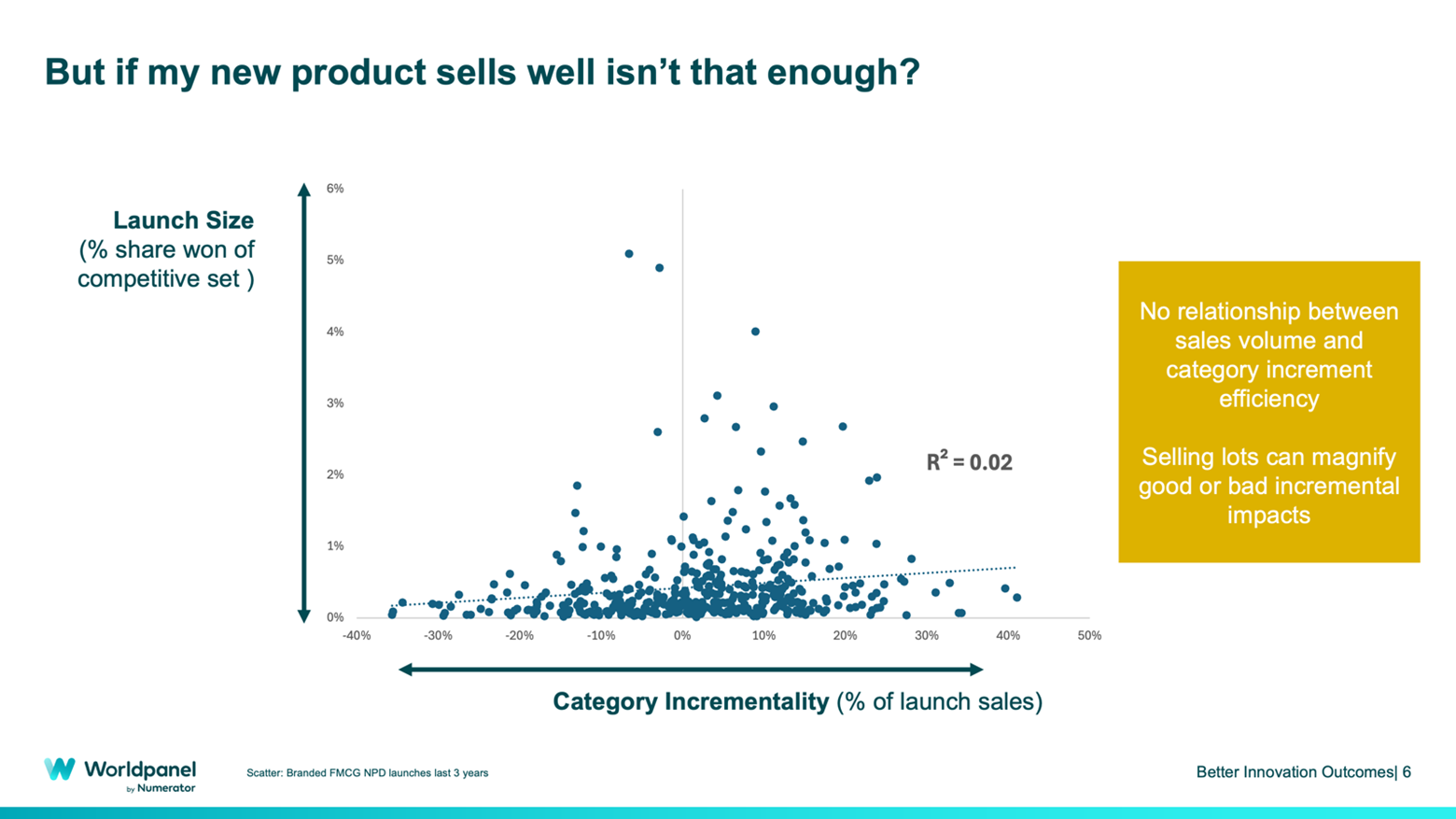
This is where drift begins. And it can go unnoticed, at least for a while. Teams celebrate the launch because the numbers look reassuring, while the behavioural signals move in the wrong direction.
Internal redistribution is the drift mechanism
When advantage drifts, the engine is often internal redistribution.
The evidence shows cannibalisation rising sharply with brand size. Brands holding 0–5% share of their competitive set typically see around 12% of launch sales drawn from their own portfolio. At 5–10% share it rises to 32%; at 10–30% it reaches 47%; above 30% it is close to 59%.
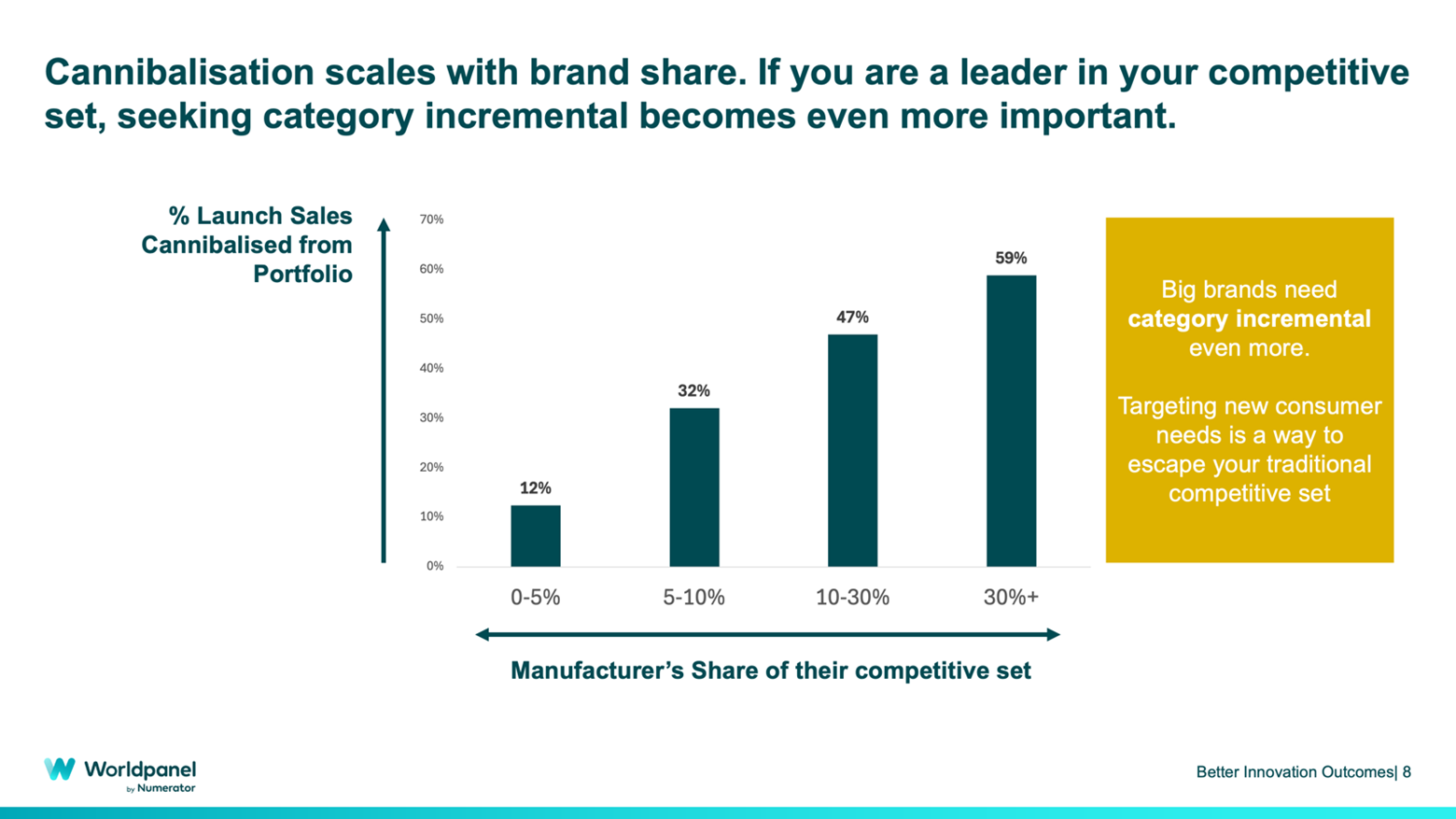
This is not automatically bad news. Some portfolio reshaping is inevitable. The risk arrives when redistribution becomes the dominant source of “success” because it changes what the brand is doing in the shopper’s life. Frequency migrates within the portfolio — the brand’s hierarchy changes. A former anchor becomes a secondary choice. Advantage drifts, even as the business continues to grow.
Finding meaning
Drift is also shaped by where innovation wins its early buyers.
When a launch relies more heavily on highly transactional channels, where the shop is driven by price, deals and speed, shoppers start to interpret the brand through those cues. The product becomes something you pick up because it is convenient or good value today, rather than because it plays a clear ongoing role in your routine. Meaning that the brand remains in the repertoire but becomes easier to replace, and it no longer functions as an anchor.
The evidence is consistent: channel positioning shapes behavioural brand role. It can reinforce what the brand is for, or it can train shoppers to see it as a situational, price-led choice.
New needs prevent confinement
One of the clearest ways to avoid drift is to reach beyond the brand’s habitual competitive frame.
Innovation that meets a new consumer need can expand the brand’s behavioural territory, reducing the gravitational pull of internal redistribution and avoiding the trap of competing ever harder for the same moments.
Innovation that stays inside familiar comparisons tends to intensify competition without creating new reasons to choose, which makes the brand easier to edge aside when routines tighten.
This is where brands often underestimate the problem. Drift does not require shoppers to turn against a brand. It is more about how the brand slips from view to become less essential.
Penetration reinforces repertoire centrality
Repertoire centrality is protected when brands continue to recruit into the inevitable “leaky bucket” of buyers. If recruitment slows, the brand increasingly relies on existing buyers to maintain volume; the repertoire becomes older, narrower, less refreshed. Advantage can still look stable, but it begins to rely on fewer behavioural pillars. This is drift.
The launch evidence directly supports this: penetration strengthens repertoire centrality. In the drift phase, that relationship becomes a warning sign as much as an opportunity, because it shows where the brand is becoming dependent on its current base.
Drinks show drift as routines tighten
Drinks makes drift easy to see because the category is living through shifting occasions and intensifying competition.
Since 2019, alcohol occasions have fallen by 1bn, while hot and soft drink occasions have declined by 3.8bn. As the day offers fewer occasions to compete for, shoppers simplify. The average household now buys 7.9 drink sectors, down from 8.6 in 2021, and 33 brands rather than 40.
This tightening does not eliminate choice, but it changes the terms of it. What does this look like? Moments collide as roles overlap. In the on-trade, soft drinks increasingly sit alongside alcohol; 1 in 3 soft drink occasions in licensed premises involve the drinker also having an alcoholic drink. Even with fewer visits overall, soft drink serves in these venues are up by around 300m compared with 2019.
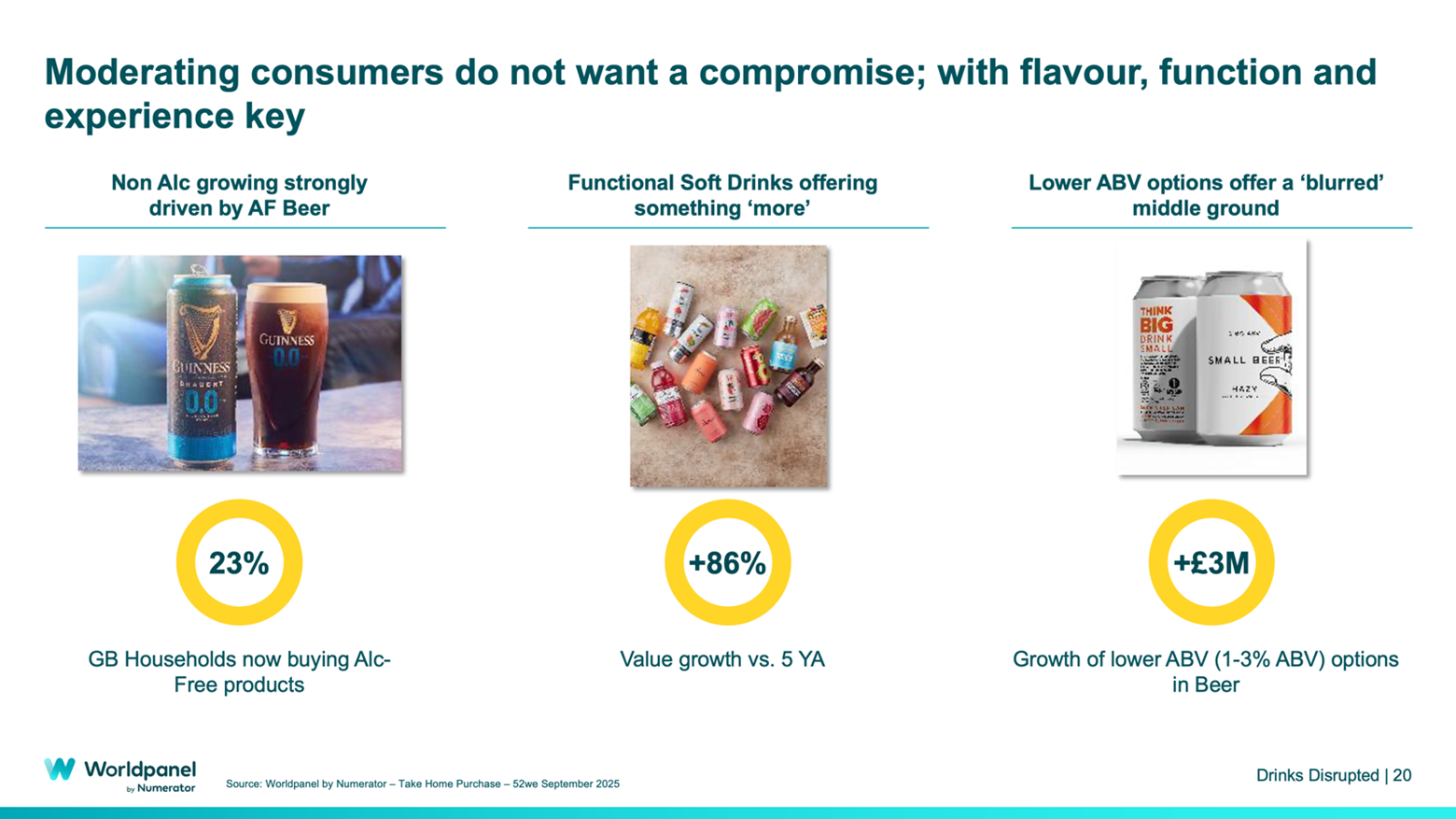
For brands, this is the drift environment. Less room for habitual repeat with more pressure on role clarity. At first glance, the brand remains present but a second look shows that it loses its former centre-of-routine status.
Watching for signposts
The evidence points to the practical warning signs of advantage drift: scale without incrementality, rising internal redistribution as brands grow, channel choices that reshape meaning, innovation that stays confined to familiar comparisons, and recruitment that slows as the base becomes increasingly self-referential.
This phase is commercially important because it feels comfortable. Growth can continue. Teams can remain confident. Yet the behavioural signals tell a different story about what is becoming easier to substitute.
Drift is measurable. It is manageable. It is also where most brands still have the most room to act, because routines have not yet hardened into a new normal.



.svg)