



South Africa’s FMCG market returned to growth in 2025, with consumer spending increasing 3.3%, a significant turnaround from the 2.4% decline recorded in 2024, according to the latest Brand Footprint 2026 analysis from Worldpanel by Numerator.
The recovery comes as local and regional brands continue to play a central role in South African households. Together, they account for 61% of Consumer Reach Points (CRPs) among the country’s Top 100 most chosen FMCG brands, highlighting the strength of brands with strong relevance to local shoppers.
Consumer Reach Points measure how many households a brand reaches and how frequently those households choose it, providing a consistent measure of brand choice across categories and markets.
South African households made approximately 3.9 billion brand choices in 2025, reflecting the scale and competitiveness of the country’s FMCG landscape.
However, the return to spending growth is not translating into gains for every brand. Among the Top 100, 49% increased their Consumer Reach Points compared with the previous year, while 51% declined. In value terms, the picture is more positive, with 62% of the Top 100 brands growing.
“This is an important shift for South Africa’s FMCG market. Spending has returned to growth, but the benefits are not being shared equally across brands. Consumers remain highly selective about where they spend their money, and the continued strength of local and regional brands shows just how important relevance remains,” said Nick Barrett, Country Manager of Worldpanel by Numerator South Africa.
Scale does not guarantee growth
South Africa’s most chosen brands already have considerable household reach. Seventy-eight percent of the Top 100 are classified as large or super brands, reaching more than 30% of households and collectively accounting for 94% of total Consumer Reach Points among the Top 100.
Yet substantial headroom remains. Almost half (46%) of the Top 100 brands still reach fewer than 50% of South African households, demonstrating the opportunity that exists even for established brands to recruit new buyers.
The analysis also points to different routes to growth depending on brand size. For larger brands with already extensive household penetration, increasing purchase frequency becomes increasingly important. For medium and smaller brands, expanding household reach remains a critical growth lever.
Among brands that grew their Consumer Reach Points by more than 2.5% in 2025, nearly eight in ten achieved growth through a combination of increased penetration and purchase frequency.
South Africa’s most chosen FMCG brands
Coca-Cola remains South Africa’s most chosen FMCG brand, generating 180 million Consumer Reach Points, followed by Sunlight (138.4 million), Albany (128.3 million), SASKO (127.7 million) and Clover (125.1 million).
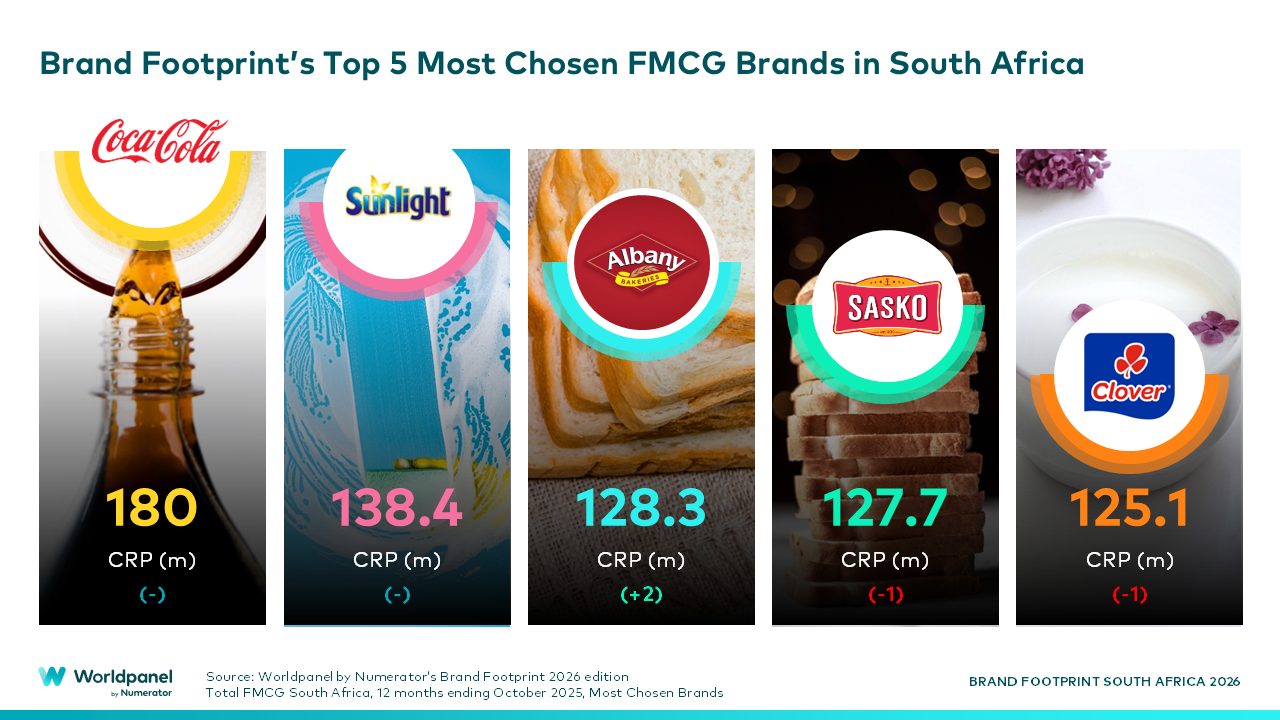
Albany moved up two positions to become the country’s third most chosen FMCG brand, while SASKO and Clover each moved down one position.
“The brands that are succeeding are not relying on scale alone. Sustainable growth comes from remaining relevant enough to attract more households while giving existing buyers more reasons to choose the brand again. Understanding the balance between reach and frequency is therefore critical to identifying where the next growth opportunity will come from,” added Barrett.
If you would like to discover the full ranking as well as which brands are leading the category rankings, reach out to our local experts.
Nick Barrett
Country Manager South Africa
Worldpanel by Numerator



.svg)