



Most marketing teams can tell you what a campaign reached. Far fewer can tell you what it moved. That gap is the hardest part of media effectiveness measurement: plans are built in one system, results are estimated in another, and the two rarely meet in the same data set.
Worldpanel by Numerator explored that gap at Consumer Connections 2026 in a session called "From Ad Exposure to Checkout: Measuring What Matters." Drawing on live brand campaign evaluations in India, it connected household level advertising exposure on linear TV and digital with what those same households actually bought.
Why Media Effectiveness Measurement Still Runs on Assumptions
Today, media planning and media measurement mostly happen in silos. TV and digital are optimized as separate lines on a plan, and impact is measured probabilistically, through questionnaires and statistical modeling.
Both are useful. Neither closes the loop on the question every CMO eventually asks: did the households that saw the ad go on to buy the brand? When exposure and purchase data come from different people, attribution stays an estimate. The past was probabilistic. The direction of travel is precision.
Connecting Advertising Exposure to FMCG Purchase Behavior
The approach shared at Consumer Connections 2026 uses a single source panel: the same households supply both the advertising exposure data and the purchase data. Nothing has to be matched or modeled across two different populations, which changes every answer that follows.
What gets captured
- FMCG purchase data, captured continuously through the household panel.
- Advertising exposure on linear TV and digital, including YouTube, Meta and OTT, captured in real time through the Sync Media app on panelists’ smartphones.
- Online actions on mobile, such as Google searches, website visits and add to cart on ecommerce and quick commerce platforms.
Built with tech partner Sync Media, it uses audio and mobile fingerprinting technology to capture exposure across platforms. Audio pitch shifting technology is used to identify ad exposure across different digital platforms. Exposure is then mapped to purchase data and online actions, and impact is reported at an aggregated level.
This panel is already live. There is a six metro panel of Individuals of approx. 3000 individuals and a South India panel launched in 2026 covering 3,500 house wives and 5,000 individuals.
What the Live Brand Evaluations Showed
An important cave at before the numbers: these learnings are based on certain brands and categories, and they cannot be applied to all categories as general learnings. Brand names have been with held to maintain confidentiality.
1. Digital added limited incremental reach beyond TV
Across the brands studied, digital reached very few households TV had not already reached. For one soap brand, 45% ofexposed households saw the campaign only on TV, 54% saw it on both, and just 0.6% were reached by digital alone. A dishwash and a detergent brand told a similar story, with digital only reach at 3.7% and 4.1%.
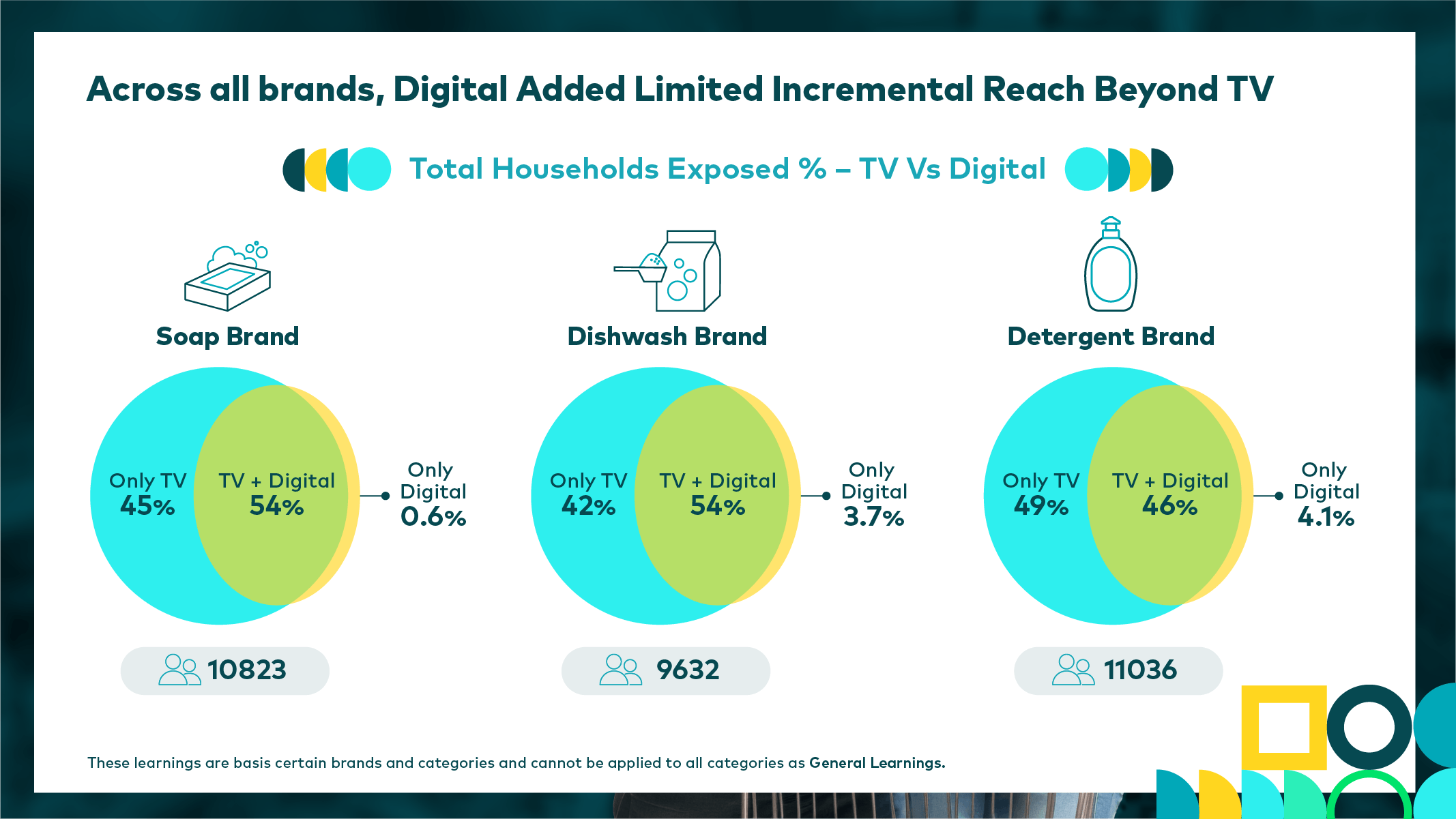
Digital was not finding new households here. Its contribution showed up somewhere else.
2. TV plus digital worked harder for nearly 75% of brands
Where households saw both linear TV and digital, brand penetration was higher for nearly 75% of the brands evaluated. One soap brand moved from 7.3% penetration among TV only households to 9.6% among dual exposed homes. Another rose from 5.9% to 9.5%.
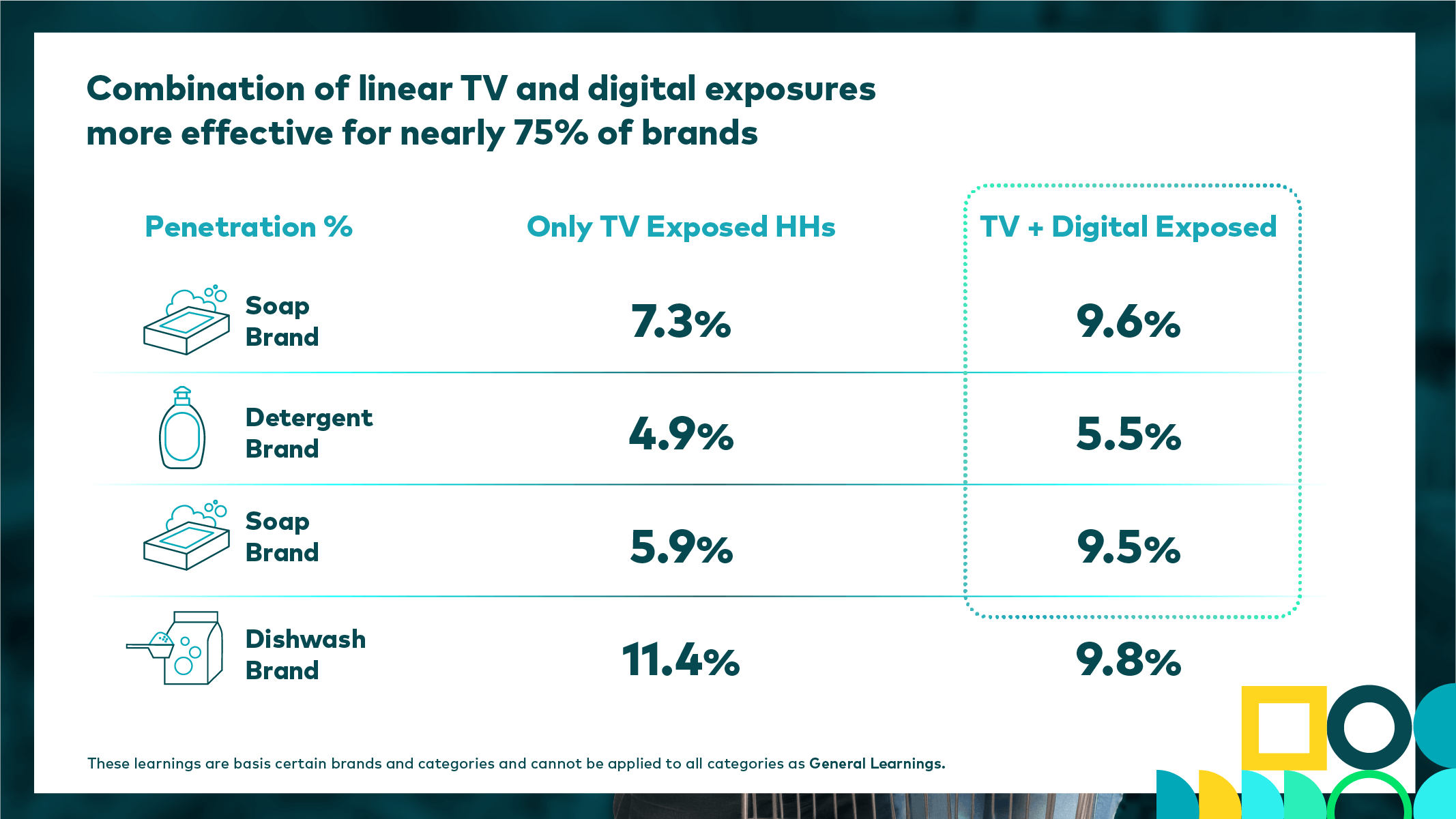
So digital earned its place by deepening impact on households TV had already reached, not by extending reach. That is a very different argument for a digital budget. Not every brand followed the pattern, though. A dishwash brand did better among TV only households, which is why cross media measurement should inform a media mix decision rather than rubber stamp it.
3. Balance mattered more than dominance
The study then looked inside dual exposed homes. Where TV carried 70% or more of exposures, results were generally weaker than where exposure was split more evenly, in ratios closer to 65:35, 60:40 or 55:45. Within those homes, 80% of brands saw a higher impact from the balanced split. One shampoo brand reached 35% penetration among balanced exposure households against 31% among predominantly TV exposed homes.
Share of exposure, not just share of spend, deserves a line in the plan.
Going deeper: The full presentation covers the frequency curves, digital format comparisons and online action data behind these headlines. Download the full report.
4. Optimum frequency is a category question, not a brand rule
There is no single right frequency. Among the brands evaluated, personal care brands gained penetration faster from incremental TV exposure, while home care brands needed noticeably higher frequency to reach a comparable point on the curve. Two brands in one portfolio, planned by the same team, can justify very different frequency caps.
The Questions Better Media Measurement Should Answer
Connecting advertising exposure to consumer behavior opens up questions most reporting cannot close:
- How effective is TV versus digital for this brand?
- Does digital add incremental penetration, or only impressions?
- Which digital platforms and formats actually work?
- What is the optimum exposure frequency on each?
- Which creative edits, time slots and channels perform hardest on TV?
- Is the brand recruiting from the cohort it intended to reach?
- Is the campaign driving online consideration and add to cart actions?
If your reporting cannot answer most of these with observed behavior rather than modeled estimates, the gap sits in the measurement, not the media.
From Ad Exposure to Checkout
Better media effectiveness measurement is not about more dashboards. It is about shortening the distance between the moment an ad is seen and the moment a product reaches the basket. The patterns above come from selected brands and categories, so treat them as a direction to test, not a rule to copy. What travels is the method: measure exposure and purchase in the same households.
The full presentation goes further: creative length and prime time effects, digital format performance, frequency curves by category, and how cross media exposure shifts Google searches, site visits and Amazon searches. Download "From Ad Exposure to Checkout: Measuring What Matters" to explore the complete findings.


.svg)