



In the previous article of this series, we explored the three shopper mindsets that emerged in the UAE amid economic and regional uncertainty: the Burdened, the Routine Protectors and the Calm Calculators. The next question is what happened after the initial shock.
The regional conflict that began on 28 February 2026 landed in the middle of Ramadan. FMCG volumes in the UAE peaked in March, driven by stockpiling behaviour and reduced out-of-home consumption. A ceasefire was announced in April, but pressure then shifted to household budgets as inflation accelerated. The headline numbers tell one story. The shoppers behind them tell three.
From shared shock to different responses
Building on the segmentation introduced in our previous articles, we analysed how the three shopper mindsets adapted their FMCG behaviour as inflationary pressure increased.
Keech & Rune’s research on panic buying has shown that attitudes and perceived risk are often stronger predictors of behaviour than demographics alone. Looking beyond averages reveals how differently households can respond to the same external event.

“The March conflict didn’t create one UAE shopper. It revealed three. What looks like a single cautious consumer in the headlines is really three families with very different worries and very different ways of coping. Any plan built on the ‘average shopper’ risks missing what is really happening beneath the surface”, said Divesh Israni, Retail & Shopper Director, Worldpanel by Numerator Africa & Middle East.
Phase one: stock-up behaviour masked emerging differences
In the three months to April 2026, FMCG spend increased by 7%, supported by growth in volume (6%) and the number of categories purchased (2.7%). This was driven by precautionary stocking-up, particularly in essentials such as food, dairy and home care, rather than by stronger underlying demand. Beneath the overall uplift, each segment responded differently:
- The Burdened (34%) took two coping steps: they reduced the number of categories they purchased and tightened their product mix through smaller packs and lower-priced options.
- The Routine Protectors (43%) took one coping step: they expanded their baskets but became more selective within categories.
- The Calm Calculators (23%) took no coping steps: they bought more volume, purchased more categories and continued trading up into larger packs and more premium options.
“Volume increased across all three groups in the immediate aftermath of the conflict, but the baskets underneath looked very different. The Calm Calculators bought more and traded up, while the Burdened were already simplifying their baskets and looking for value. A spike in spend should not automatically be interpreted as stronger demand”, added Israni.
Phase two: three months on, the segments split
By July, the picture had changed. Inflation's contribution to FMCG spend growth had increased from 5.2% in April to 10.6%, while volume growth slowed from 6% to just 1.3%. Growth was increasingly being driven by price rather than consumption.
This pattern is familiar: global FMCG markets experienced similar dynamics during the inflationary pressures of 2022, when spend growth outpaced volume growth as households paid more while buying fewer items.
The three shopper groups then began to diverge significantly.

The Routine Protectors (43%) moved the most
The largest segment shifted from stocking up to actively pulling back. They reduced volume, dropped categories and showed significant changes in their product mix from month to month.
The Burdened (34%) found a new lever
Their initial stock-up behaviour faded, and store choice became increasingly important. Rather than continuing to adjust packs and products, they began shifting towards cheaper retail channels.
The Calm Calculators (23%) stayed the course
Despite rising inflation, they continued purchasing more volume and maintaining a broader category repertoire, showing little evidence of defensive behaviour.
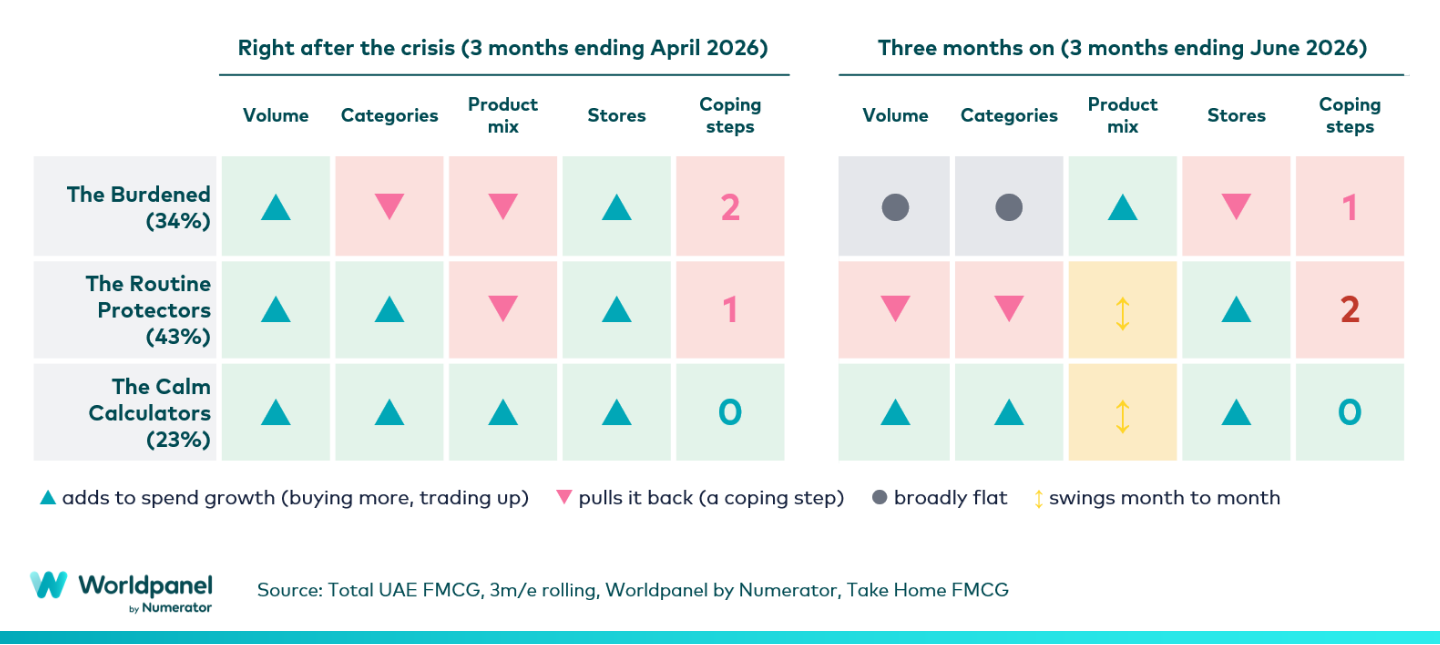
Purchase behaviour reveals what shoppers actually do, not simply what they say they will do. By June, only the Burdened had clearly shifted towards lower-cost stores, while the much larger Routine Protector group was reducing volume and removing categories instead.
“The shock was short, but the adjustment played out slowly and differently across households. The biggest surprise was the Routine Protectors. On the surface they appeared stable, yet they became the group making the most meaningful changes to their baskets. For many brands, the bigger risk is not shoppers trading down, but shoppers deciding a category is no longer essential”, said Israni.
What should brands and retailers do?
The first question is not what action to take. It is which shoppers make up your franchise. A brand over-indexing among Burdened households faces a very different challenge from one whose buyers are predominantly Calm Calculators. The right commercial response depends on understanding where pressure is concentrated.
Applying the lens beyond the UAE and beyond FMCG
These findings reflect total UAE take-home FMCG behaviour and should not be assumed to apply directly to Saudi Arabia. The critical next step is understanding whether similar shopper groups exist in Saudi, how large they are, and how they are influencing category performance.
A category with a high concentration of Burdened shoppers may require very different actions from a category dominated by Routine Protectors or Calm Calculators. Understanding that mix is essential for making effective decisions on pricing, packs, promotions and assortment.
Which shopper mindsets are driving your category?
The UAE experience shows that headline FMCG trends can mask very different shopper behaviours underneath. Applying the same lens in Saudi Arabia can help manufacturers and retailers understand where growth is coming from, where risks are emerging, and which shoppers matter most to future performance.
To understand how these shopper mindsets could apply to your category, brand or retail franchise in Saudi Arabia or the UAE, get in touch with our local experts. We can help quantify the opportunity, identify the risks and turn shopper understanding into action.
Divesh Israni
Retailer & Shopper Director, Analytics, AME
Worldpanel by Numerator Africa & Middle East


